For most of the day there is no racecourse at Claddaghduff. There is the Atlantic, and a channel of water about six hundred metres wide separating Omey Island from the west Connemara mainland. Then the tide goes out, a mile of firm sand appears, and a few hundred cars drive onto the seabed to watch horses run on it.
The Omey Races happen once a year, on a Sunday chosen by the moon rather than by a calendar. I drove up from Limerick with the camera club — about three hours — for the 2026 meeting on Sunday 2 August. It was the first running in two years, and the first ever held with a maritime area consent in hand. It rained more or less all day.
An island that is only sometimes an island
Omey — Iomaidh Féichín in Irish, Féichín's bed or seat — sits roughly 600 metres off the Galway coast near the village of Claddaghduff, and is about a mile across in each direction. Claddaghduff itself is An Cladach Dubh, the black shore. The island rests on the Omey Granite Pluton, among the oldest granite in Connemara, and people have been living on it for at least 5,000 years.
The crossing is what makes it unusual. A tide of around ten feet pulls back twice a day and opens a mile of sand firm enough to drive a horsebox across, Atlantic on one side, the Twelve Bens on the other. That window — a few hours, twice daily — is the entire basis of the event. It is also why people get caught out. Sand that carries a car at two o'clock is under enough water to drown one by early evening.
What is under the sand
The name points at the island's oldest story. Omey is associated with a monastery and settlement reportedly founded by St Féichín, and archaeologists from University College Dublin began studying its monastic heritage in the early-to-mid 1990s. The excavation produced something rare: one of the few known burials of a woman inside a monastic burial ground, on a site believed to date from the early sixth century. The ruins of Teampall Féichín, a medieval church raised on that earlier Christian ground near the northern coast, lay buried under sand until 1981. St Féichín's holy well is on the western side, above a rocky inlet.
Then there is the population history, which is the history of the Irish west compressed into one small island. Omey held 396 people in 1841. A decade later, after the Famine, that had almost halved. By 1926 the count was 71. By 1988, three families. The school closed in 1973. The last permanent resident, Pascal Whelan, died in 2017 — a former wrestler and professional stuntman who had worked with Paul Hogan on Crocodile Dundee and taught Peter O'Toole to sword-fight for a screen Macbeth. The poet Richard Murphy lived there for a time and built an octagonal retreat that still stands. The island is used seasonally now, but it remains the main burial ground for the district.
So the horses run across the doorstep of a place that emptied out and never refilled. That is worth holding in your head on race day, when several thousand people are standing on it.
A farmers' meet, a 39-year silence, and four people who restarted it
Nobody can date the meeting precisely. Asked how far back it goes, organiser Féichín Mulkerrin has put it: "Long before my grandfather remembers."
It began as a farmers' meet for working horses, on a card that also carried currach races, athletics, a bicycle race — and a car race one year. The actress Olwen Fouéré, who grew up in Connemara, remembered the old version as closer to a fair, with stalls, sideshows and athletics.
The races stopped in 1963, and stayed stopped for thirty-nine years. In 2000 a four-person committee — Féichín Mulkerrin, Malachy King, Tom Delappe and Trina Sweeney — decided to bring them back for the millennium, and the first revived meeting ran in 2001. Mulkerrin, an islander and an Office of Public Works warden, was the one who restarted a festival that had been gone longer than many of its riders had been alive.
The relaunch was improvised and it worked. That 2001 card of seven races was planned in under three weeks, drew entries from as far as Donegal, and was funded by a race night in Sweeneys pub in Claddaghduff plus local sponsors. The first race, the Knockbrack Derby, went to Forgive and Forget. The two-mile Clifden Plate was the longest of the day.
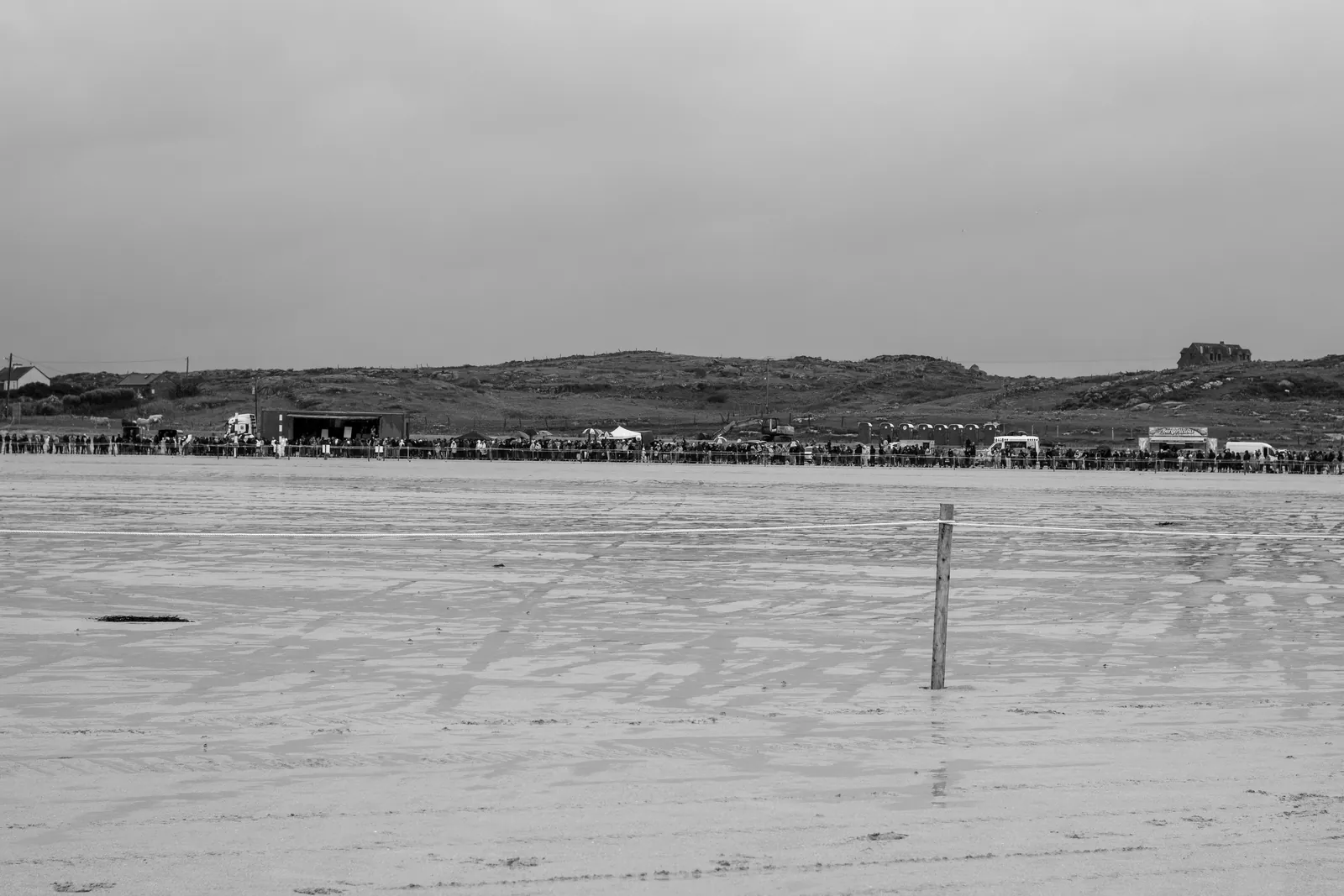
By 2010 it had scale. An estimated 5,000 people turned up — the biggest crowd in years — to a meeting the Irish Times christened "the other Galway Races," a barefoot, tweed-cap counterpoint to Ballybrit. In the opening race that year, two of the three runners missed the first bend and galloped off toward the open sea. Racing was paused while stewards put up extra fencing. That detail explains the shape of the course, and it explains where the photographs come from.
The year the paperwork won
Covid stopped the meeting, and it stayed suspended for several years — first by the pandemic, then by an insurance gap. It returned in 2024, though weather pushed it from 4 August to 24 August.
Then came the regulatory shock. Days before the 2025 running, the organisers learned they could not proceed: they had no maritime area consent. Mulkerrin said he had not known a MAC was required, and had not heard of the Maritime Area Regulatory Authority until that week — the National Parks and Wildlife Service had already given permission. MARA's position was that under section 80 of the Maritime Area Planning Act 2021, an event like Omey needs a consent, and it noted it had already granted them for the Laytown horse racing festival in Meath and the Geesala horse and dog racing festival in Mayo, whose organisers had applied the year before. The Omey committee was also told an engineer's report on the location would be needed alongside a new application. With no time left, the 2025 races were called off.
The 2026 meeting was the correction. Several thousand people were expected at low tide on Sunday 2 August for a card of eight races starting at 2pm, with spring tides giving a wider working window. The committee had its MAC, and Galway County Council, the NPWS and the Garda had all given authorisations. Local listings put the card at up to nine races with the first off at 1pm — the honest answer being that the tide sets the time and the published hour moves.
| Year | What happened |
|---|---|
| c. 6th–7th C. | Monastic settlement associated with St Féichín; a church is later built on the site |
| 1841 | Island population 396 |
| Pre-1963 | Farmers' meet — working horses, currachs, athletics, a bicycle race, one car race |
| 1963 | Races suspended |
| 1973 | The island school closes |
| 1981 | Teampall Féichín excavated out of the sand |
| 2000–01 | Four-person committee revives the meeting; seven-race card in 2001 |
| 2010 | Crowd estimated at 5,000 — "the other Galway Races" |
| 2017 | Pascal Whelan, the last permanent resident, dies |
| 2019–23 | Last pre-Covid running in 2019; suspended by pandemic, then insurance |
| 2024 | Returns, postponed by weather to 24 August |
| 2025 | Cancelled — no maritime area consent under the Maritime Area Planning Act 2021 |
| 2026 | Runs 2 August with MAC, council, NPWS and Garda authorisations |
Watch: three minutes on Omey Strand
Stills do the bend well and do the noise badly. This is what it actually sounded and looked like from the rail.
Race day, Sunday 2 August 2026
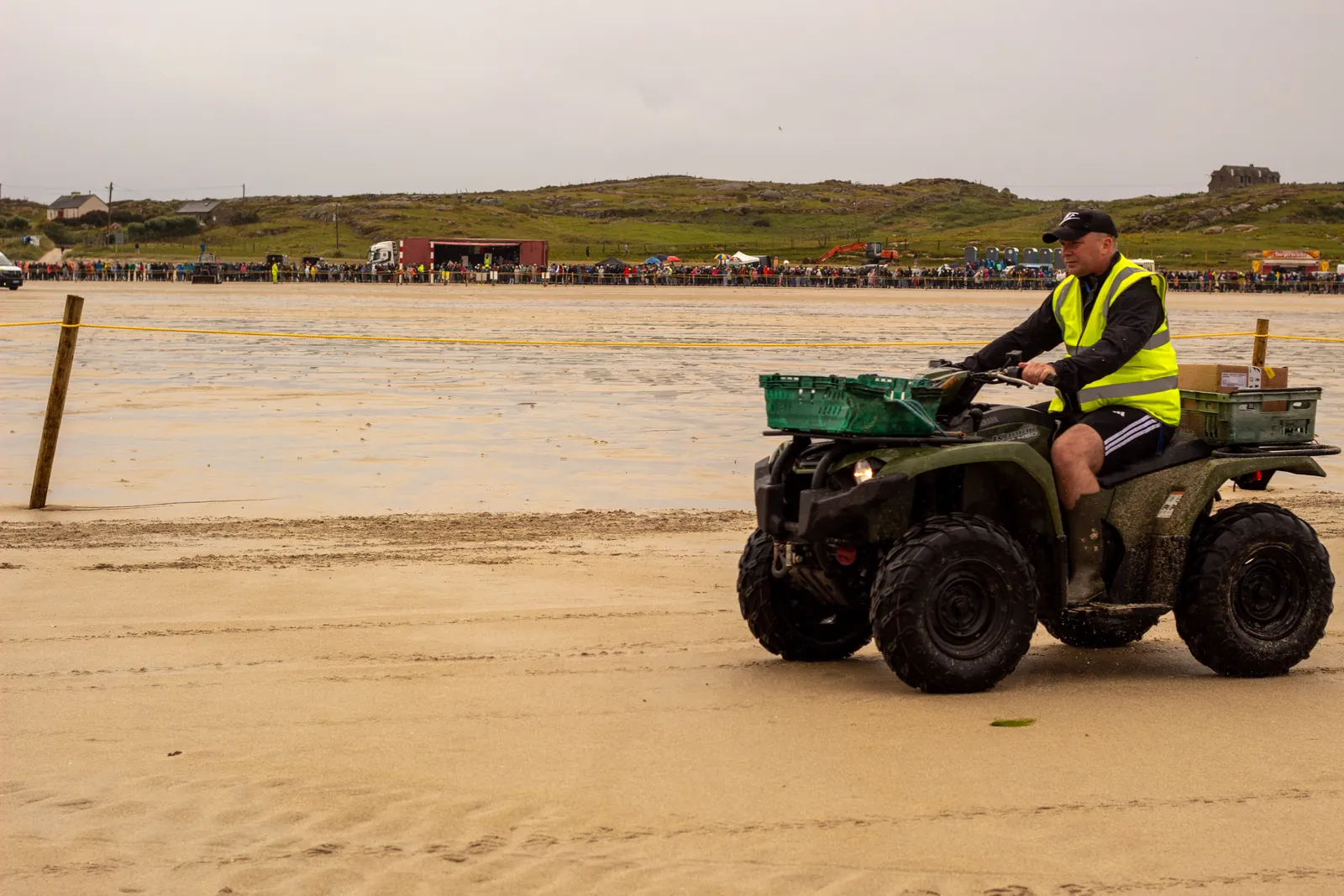
We got one of the limited spaces in the parking area and walked out to the course. Most people don't get that option — several hundred cars drive out across the strand itself and park near the track, which is a spectacle in its own right before anything has run.
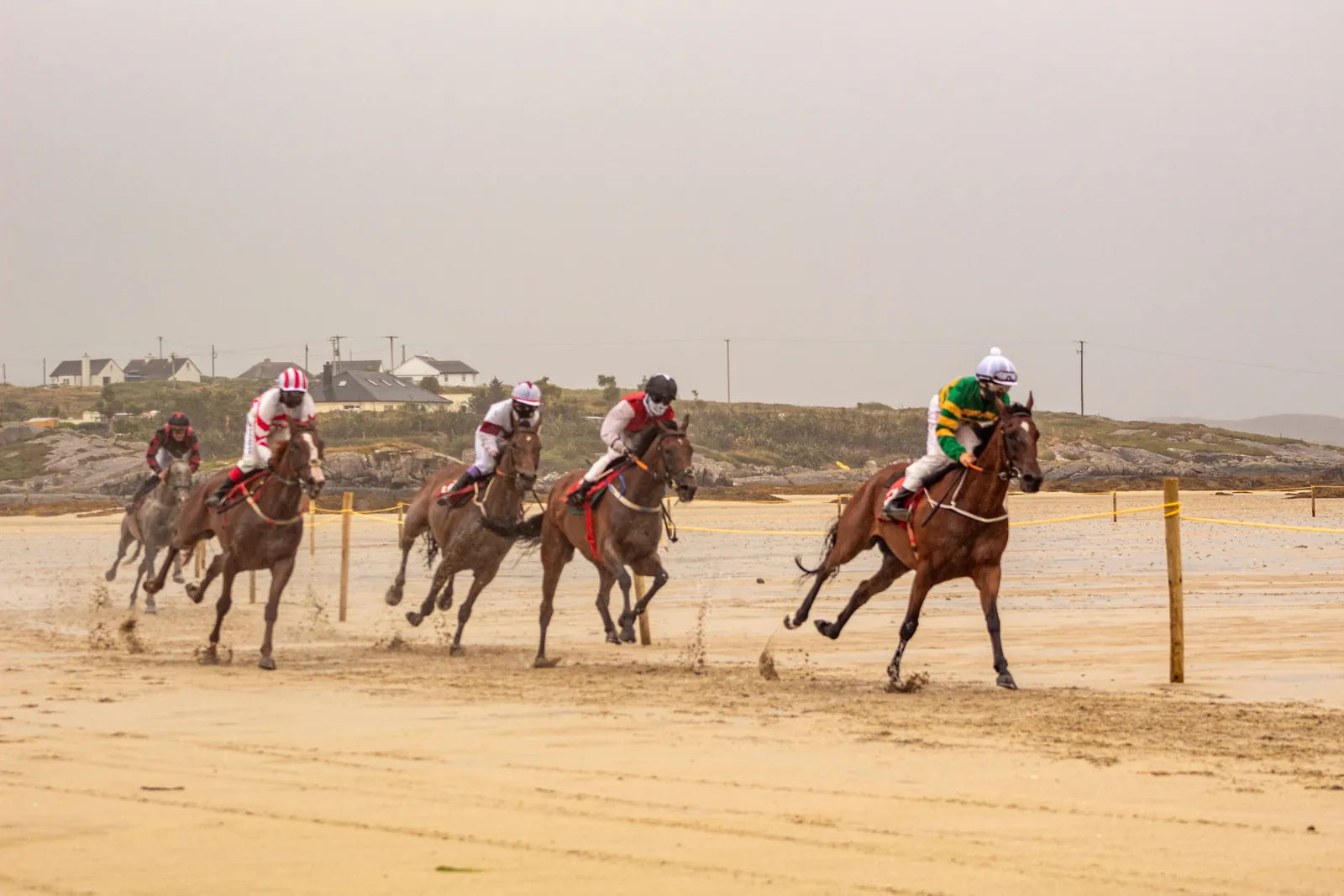
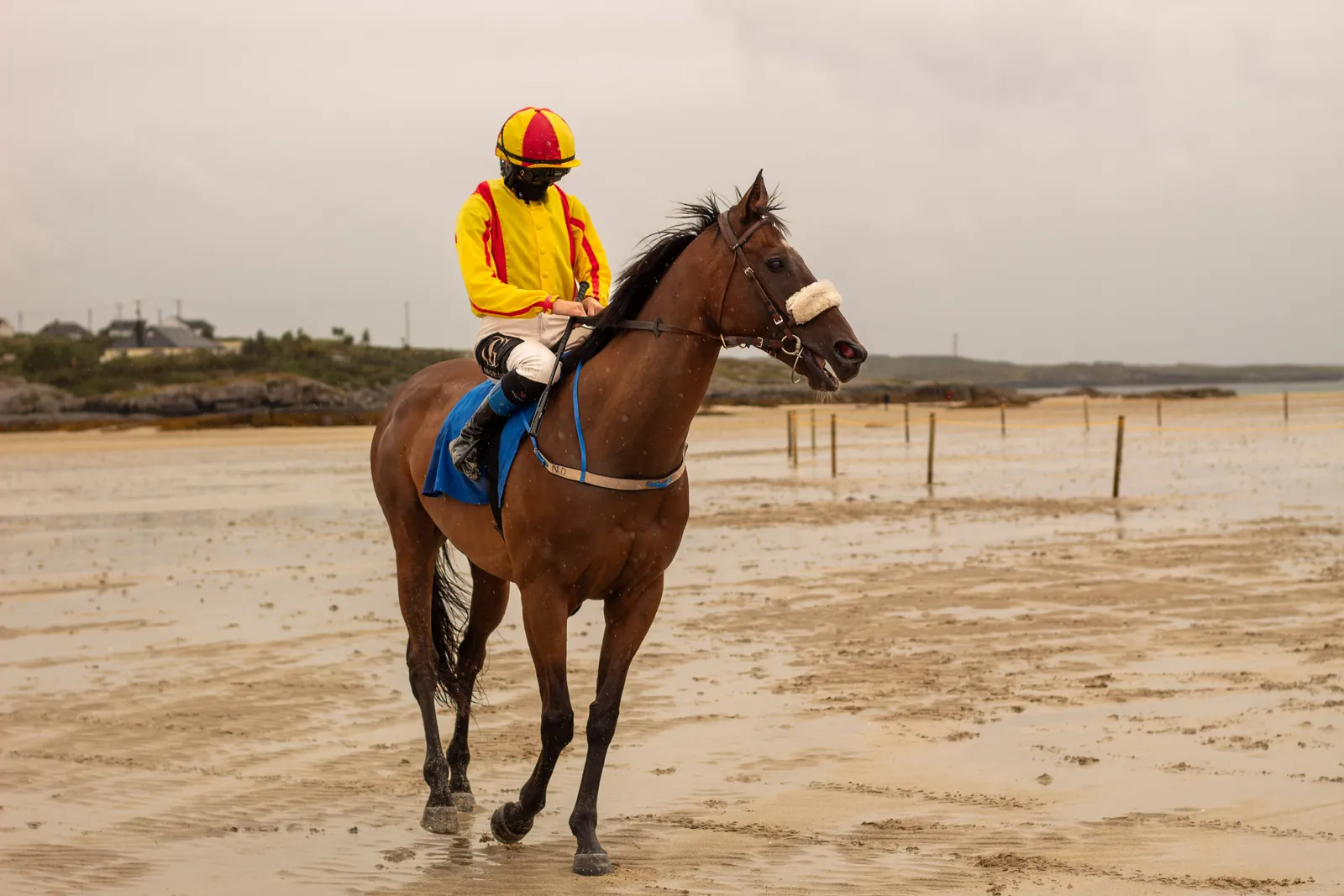
The tide had pulled back to open a huge flat of sand, and the usable window ran from around midday until roughly five o'clock. Horses were brought down and held ready; jockeys mounted at the last minute. Racing ran anticlockwise, most races over about two to two and a half laps at full pace.
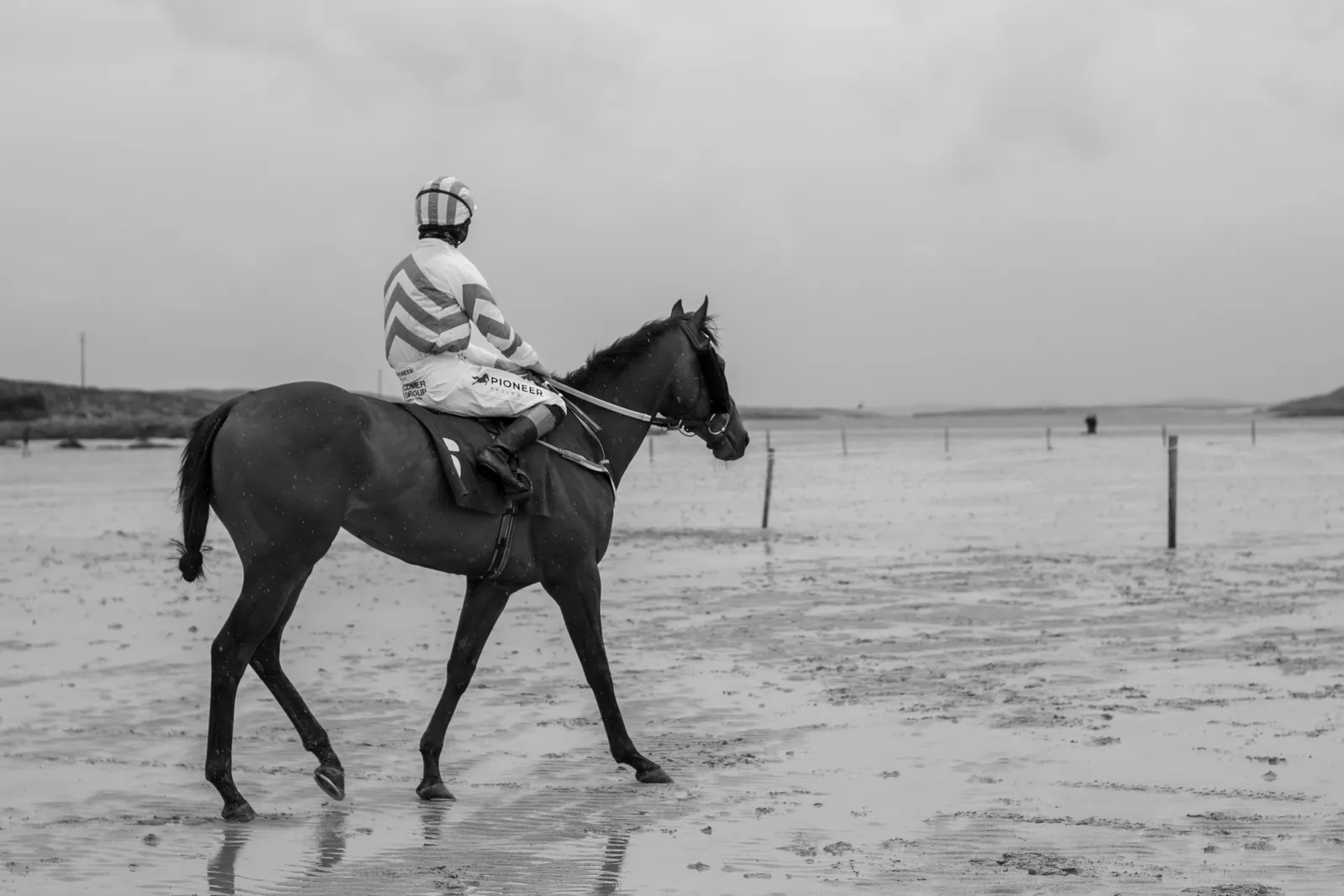
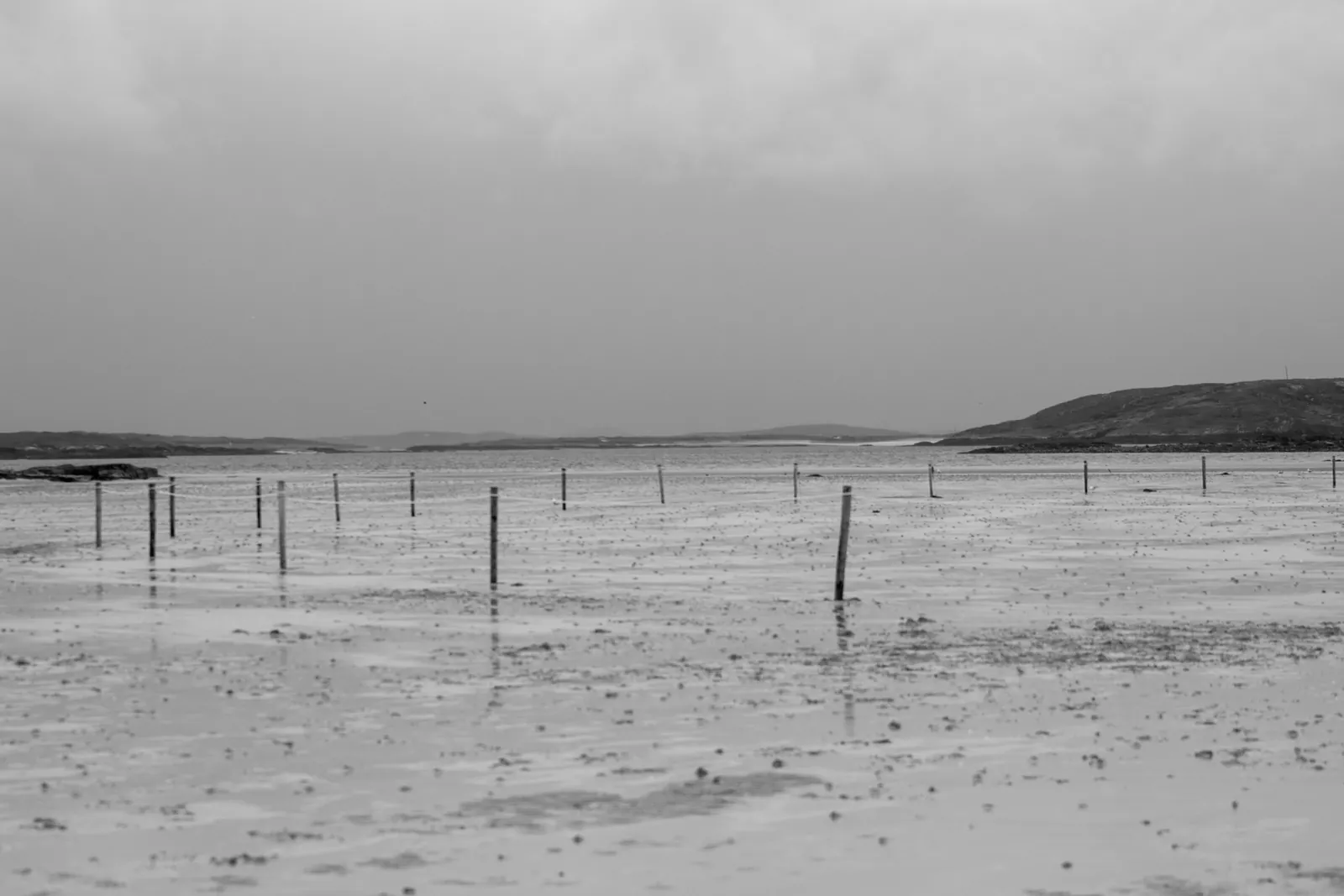
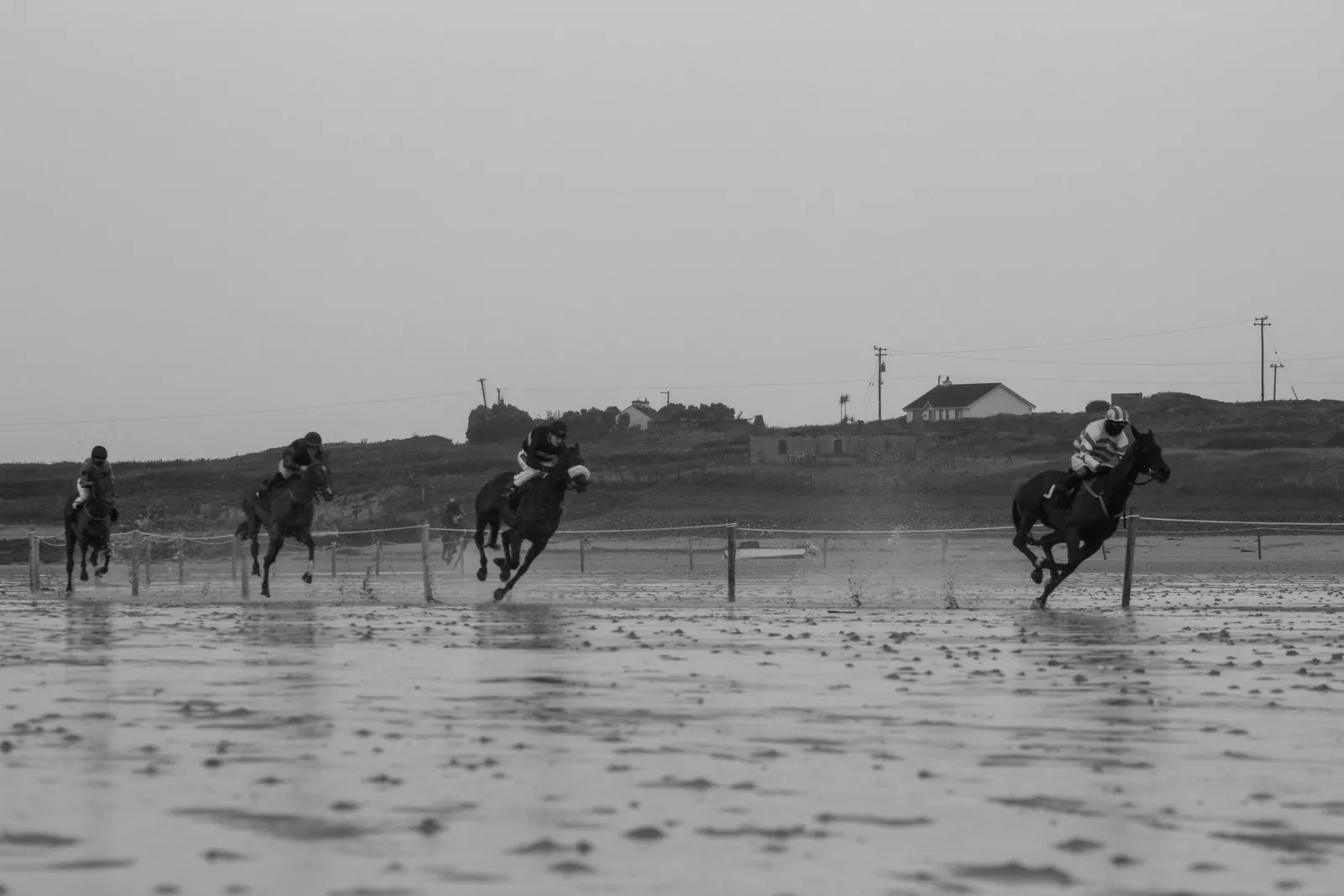
The scale takes a while to register. From the rail the far side of the course is a thin dark line, and a whole field of horses at the top of the strand looks like a smudge against the water.
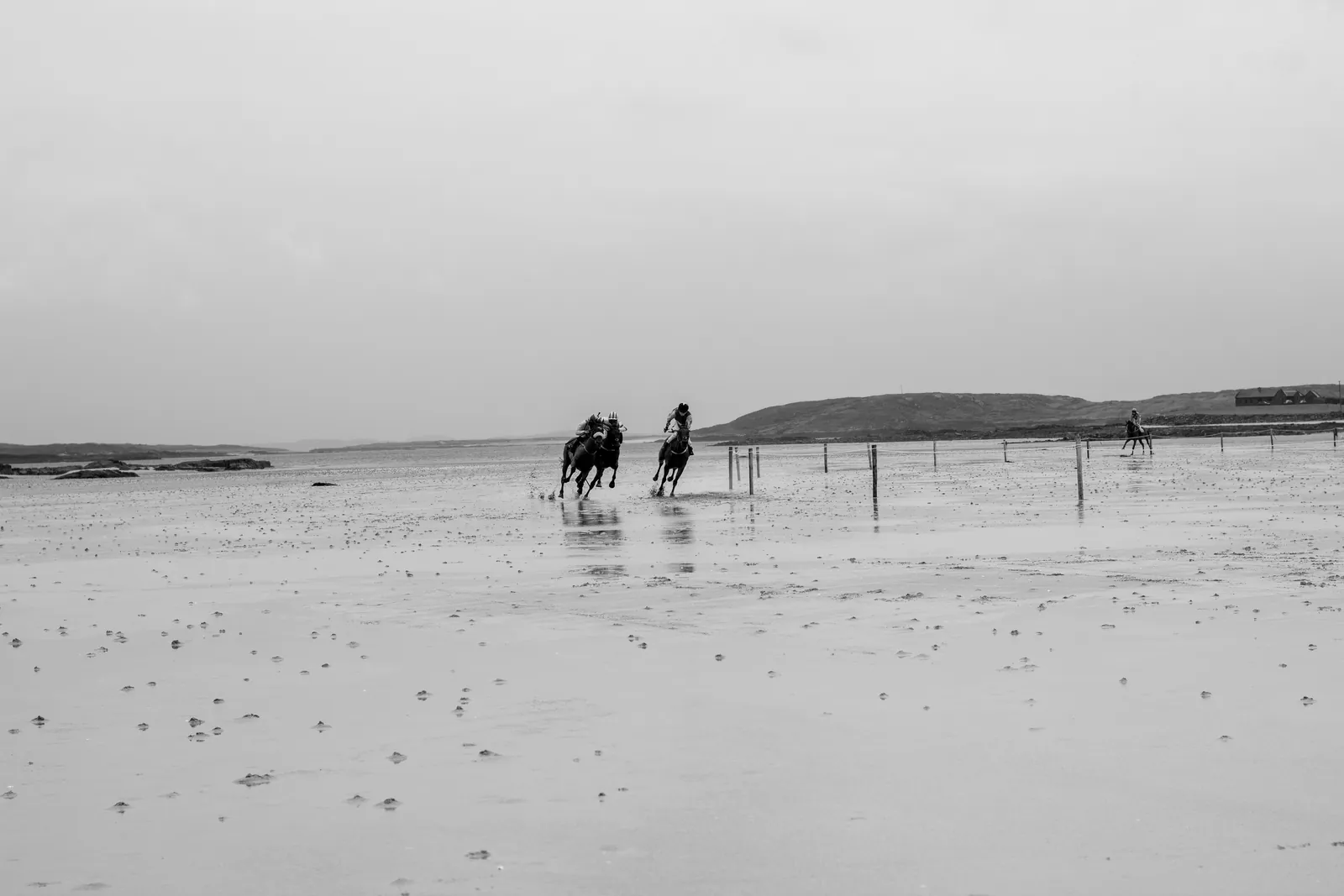
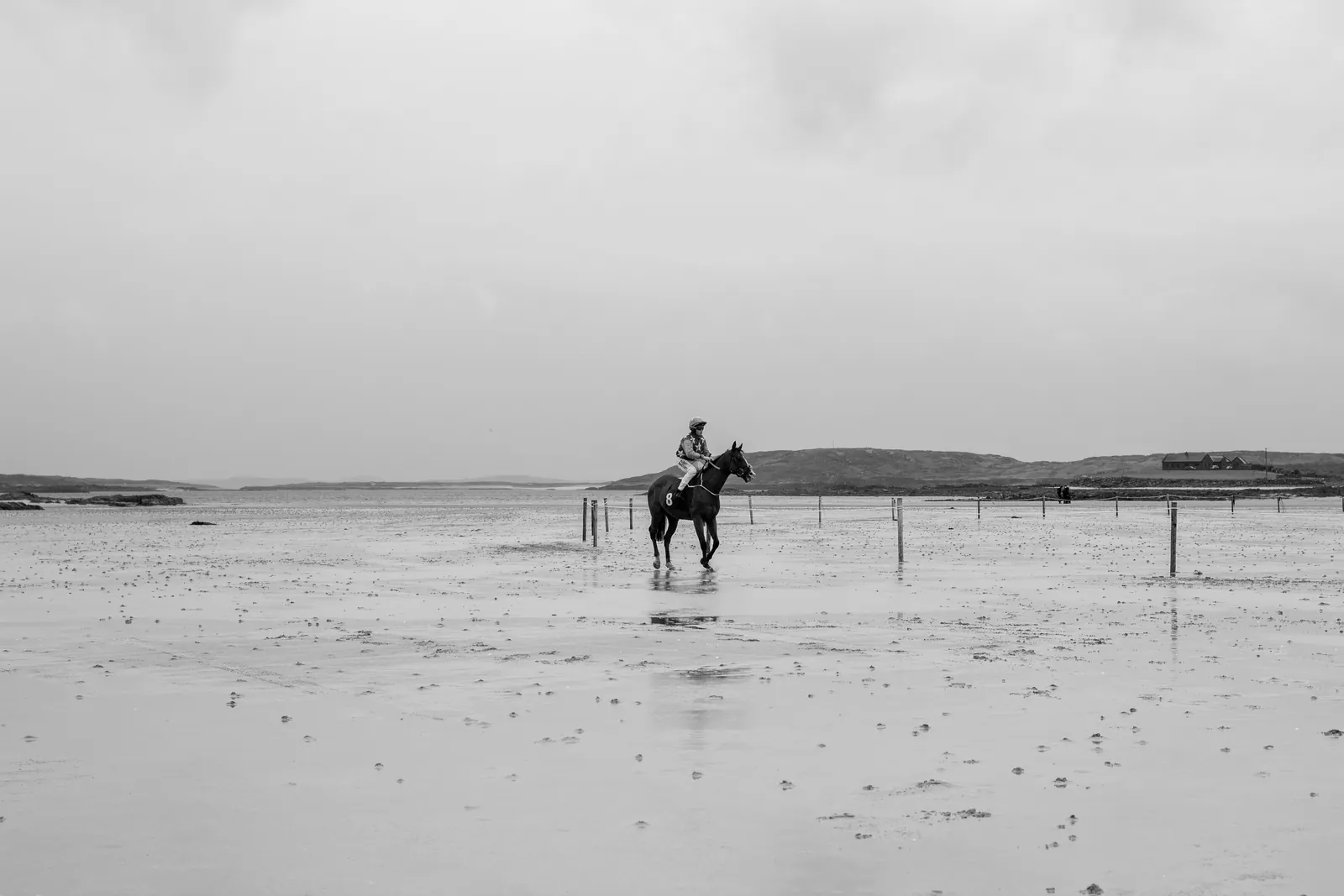
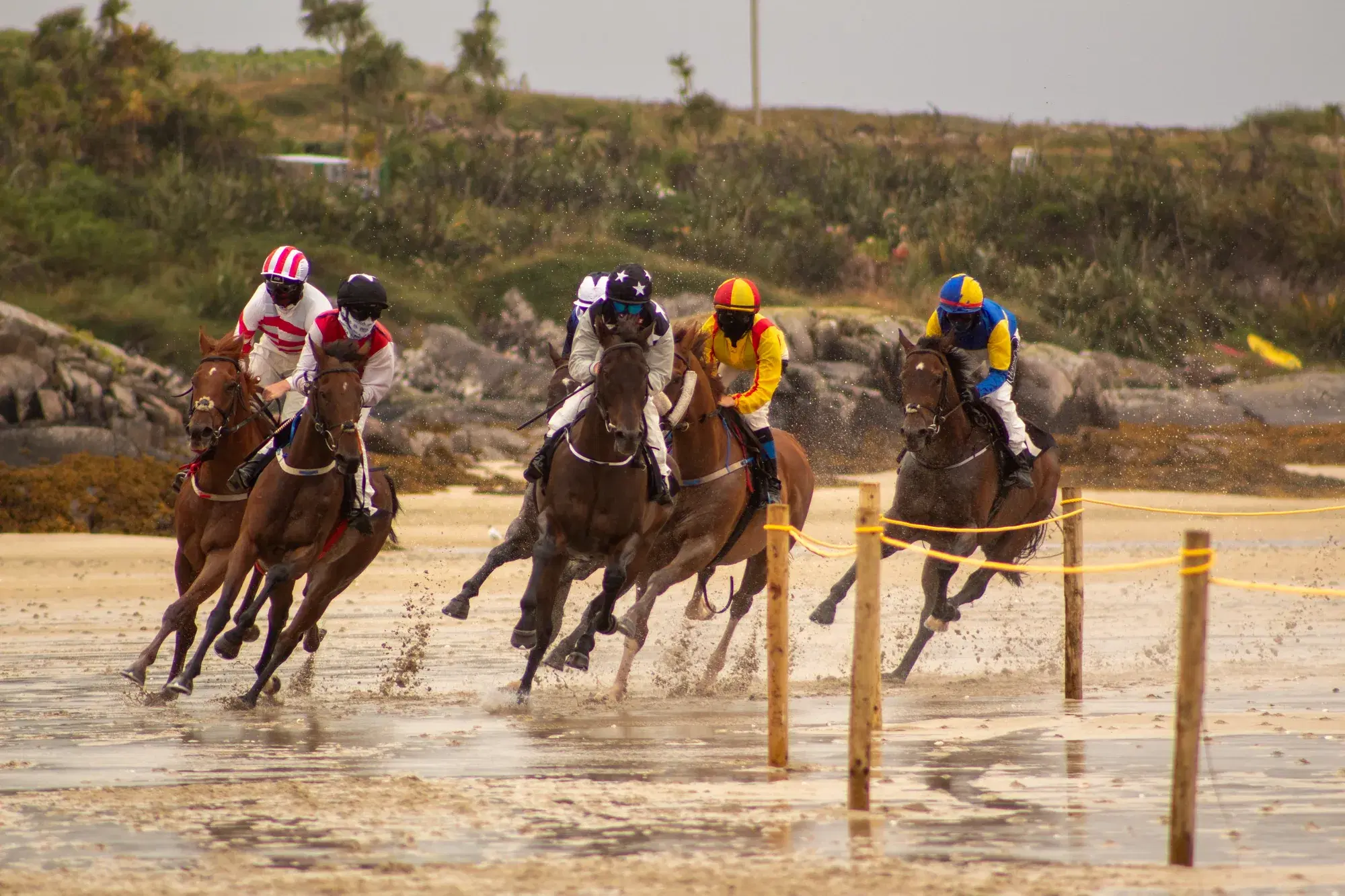
Then they come around the bend and it stops being landscape photography.
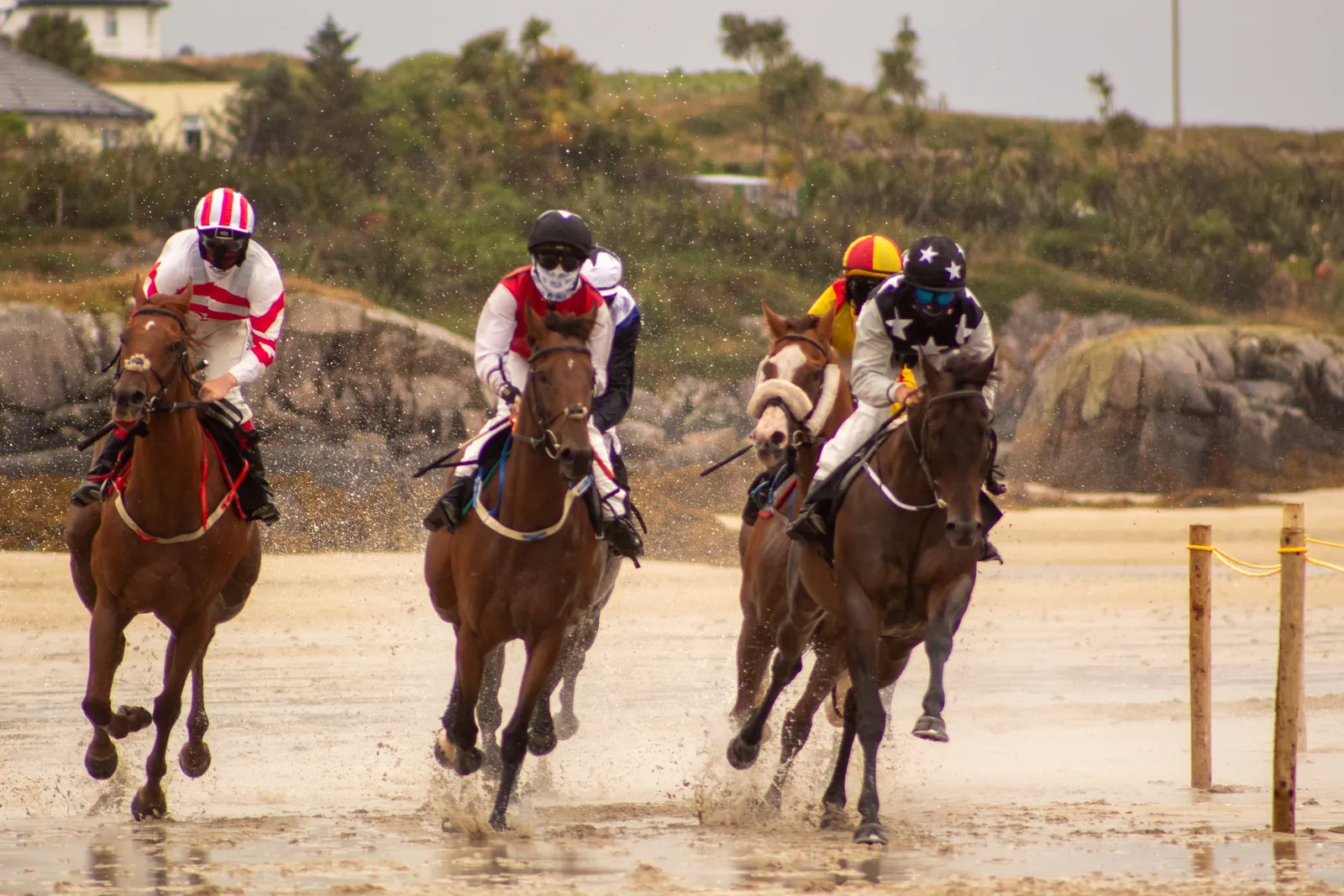
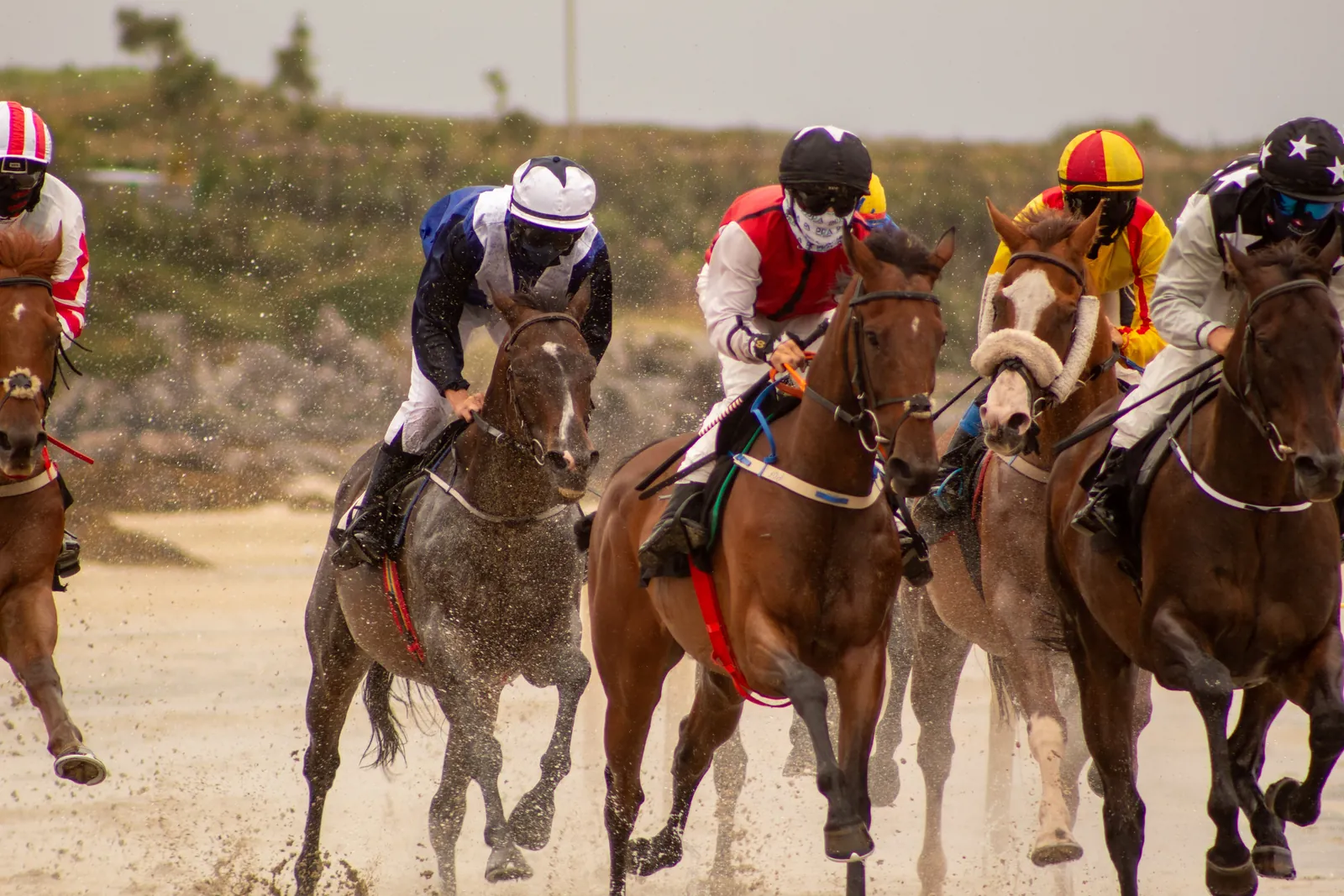
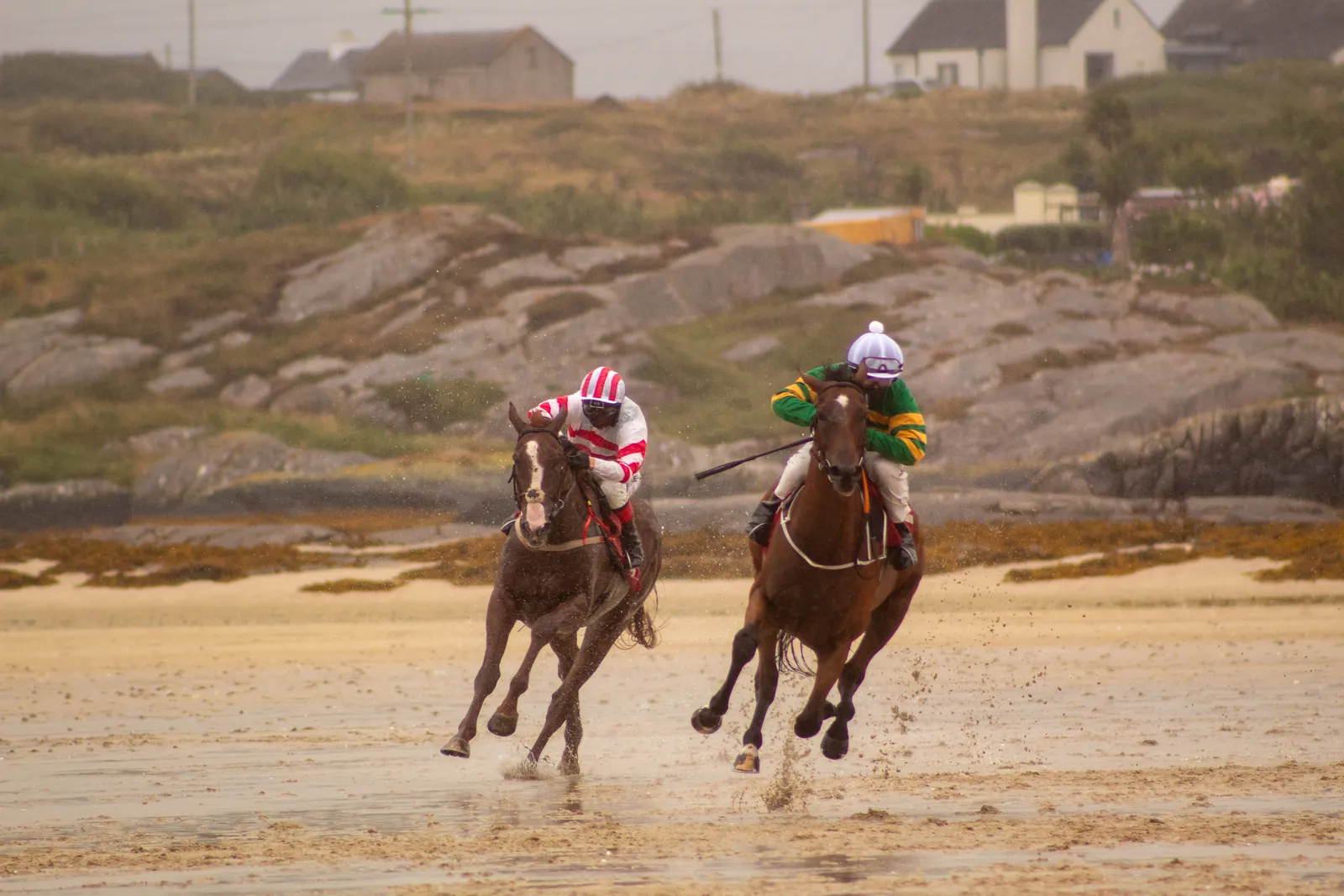
It rained hard for the last of it. We stayed for about four races before the weather won. In one of them a rider came off at speed on the flat — he got up and was fine, but it was a reminder of what this actually is: a marked-out course on wet sand, run by volunteers, at racing pace.
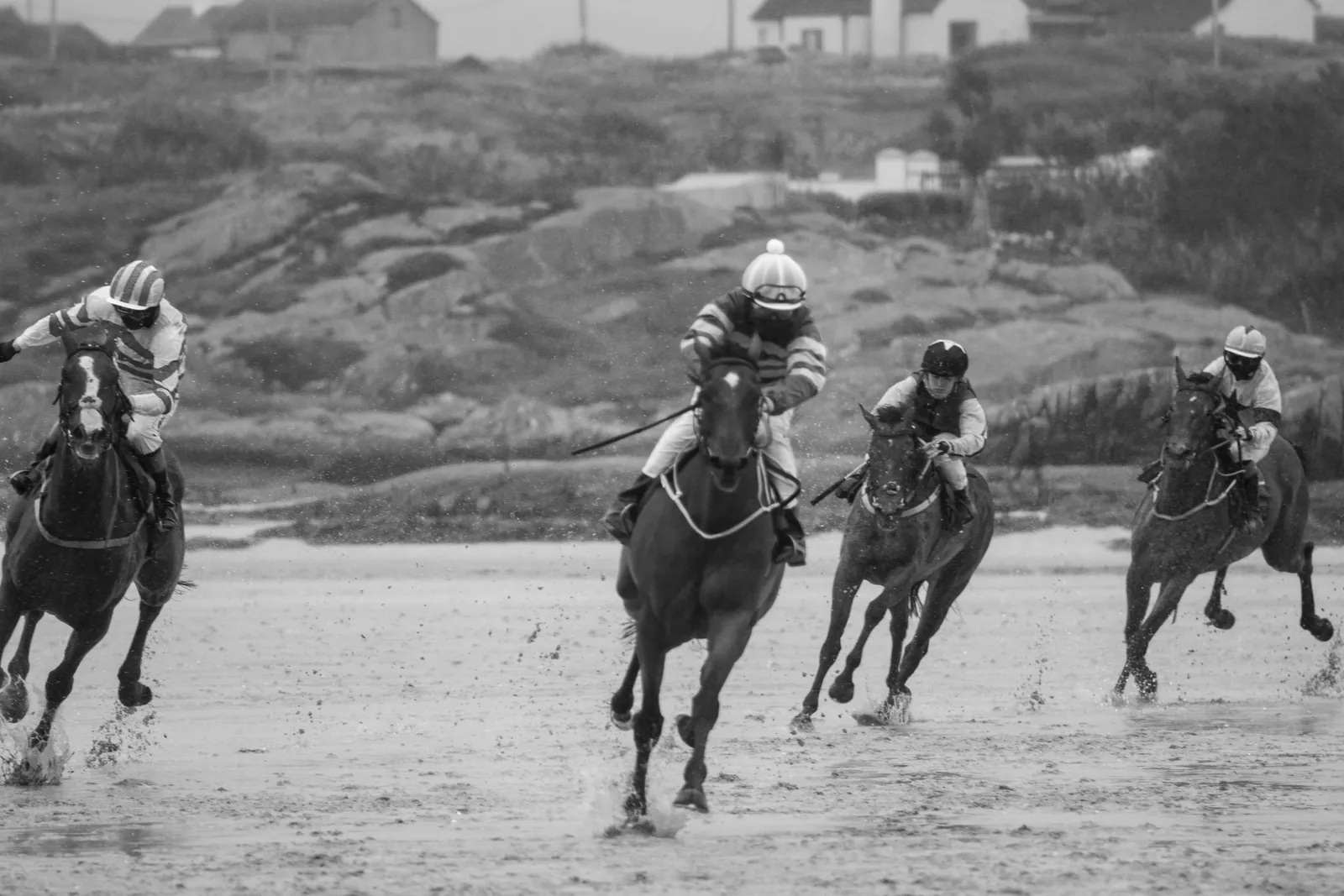
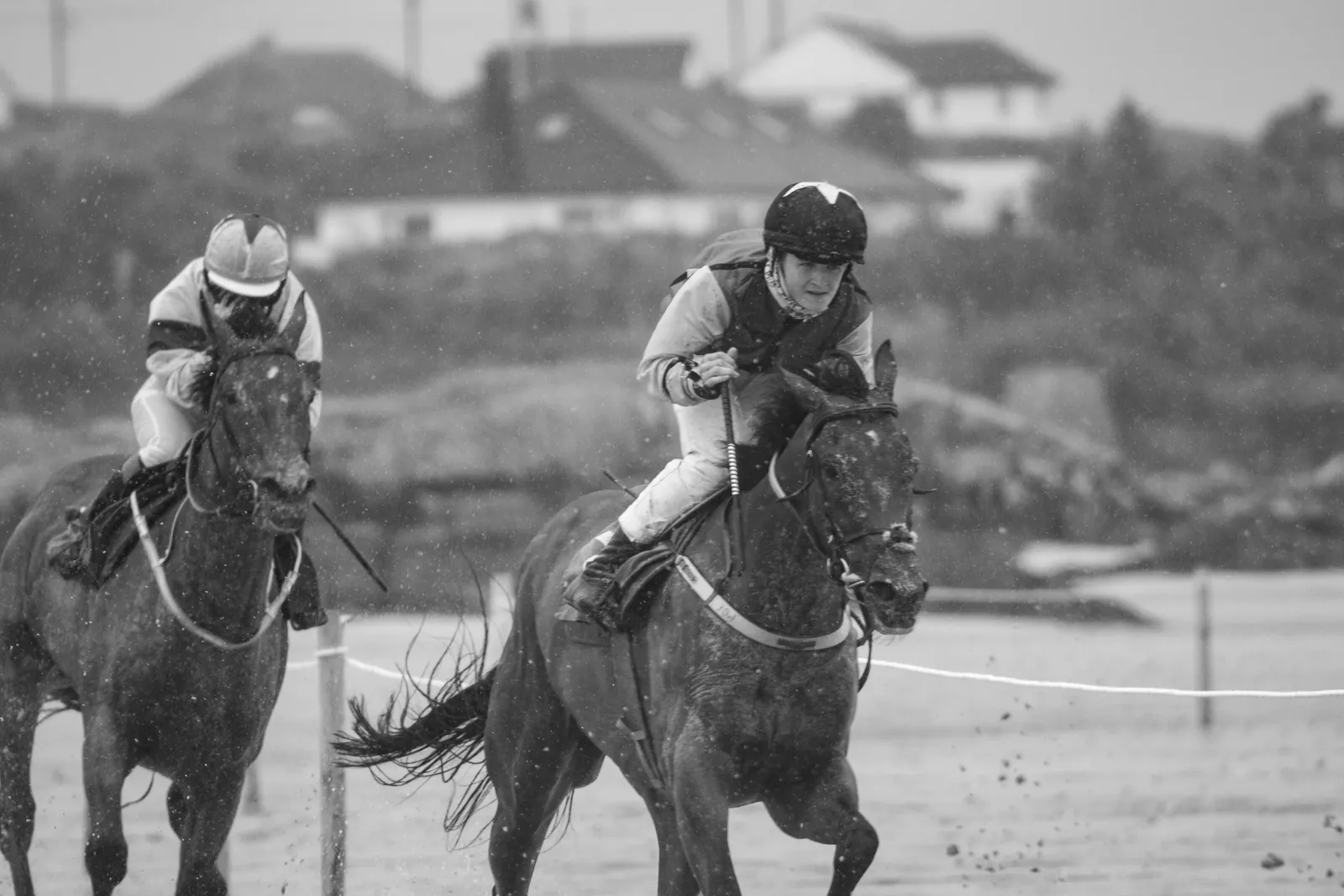
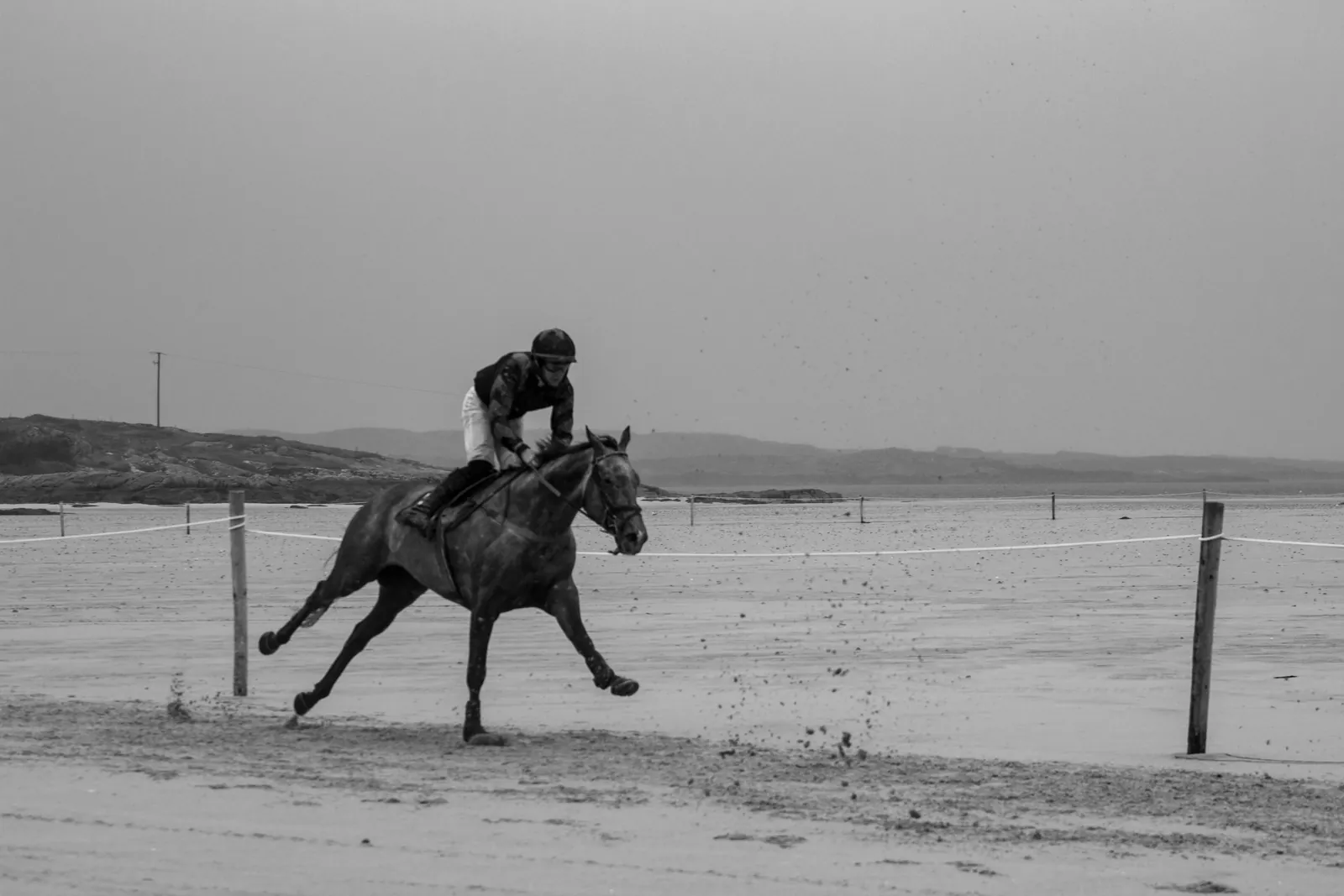
That was my first time watching horse racing of any kind, and the setting does most of the work: mountains behind, sea in front, and a course that will not exist in three hours.
Omey and Laytown: two kinds of beach racing
Beach racing used to be ordinary in Ireland. Laytown in Co. Meath has run since 1868, when the races were staged alongside the Boyne Regatta at a time when strand racing was fairly common. They were meant as a side attraction to the rowing and quickly took over. Laytown is now the only Irish meeting run on a beach under the Rules of Racing — one day each September, on a straight, near-level track of six and seven furlongs, with starting stalls since 2015.
Omey is the other kind: a community meeting run by a voluntary committee, outside that regulated fixture list, on a course marked out as a circuit rather than a straight line. That structural difference is the whole reason the two look nothing alike in photographs. Laytown horses run in one direction down a beach; Omey horses run laps with bends — and the bend is where everything happens, for riders and for anyone with a camera.
Around the racing there is a festival: food and drink stalls, live music, pony equipment sellers, traditional basket makers and bookmakers.
Notes for photographers
What I ran on the day: 1/1000 sec, f/5.6, centre-weighted average metering, AI Servo continuous autofocus. I positioned toward the far end and shot the horses coming through the curve, which produced the strongest frames of the day. What I would change next time:
- Shutter. 1/1000 freezes the body but not always the hooves and the sand spray head-on. 1/1600 is safer for oncoming shots. Keep a few frames at 1/125–1/250 with a deliberate pan — a blurred background sells the speed better than a frozen frame does.
- Metering. Wet sand is a mirror. Centre-weighted holds up on a flat grey day, but the moment the light breaks it will underexpose dark horses badly. Dial in +1/3 to +2/3 EV, or spot-meter the silks.
- Focus. On a bend, a single centre point loses horses that drift. Zone or expanded-area AF with servo tracking holds better, and back-button focus lets you keep tracking through the turn without the shutter resetting anything.
- Position. Inside the turn gives you the lean. Low and close to the rope gives you drama. The finish gives you the crowd. The bend is the highest-yield spot.
- The other pictures. The horseboxes crossing the strand, the bookmakers' boards, barefoot kids, and the run for the mainland before the tide fills in are often the frames that carry the story. The dash across the sand ahead of the water is one of the meeting's signature moments.
- Weather and salt. Rain cover, hood on, wipe the front element between races, change lenses in the car, rinse the tripod legs afterwards. Salt spray plus sand is harder on gear than rain alone.
If you want to go
- The date moves. It is tied to a suitable low spring tide, typically late July or early August, and the start time shifts year to year. Check the organisers' Facebook page in the week beforehand rather than trusting a listing — even in 2026 the published start ranged from 1pm to 2pm depending on the source.
- Getting there. Access is signposted from the N59 out of Clifden, through Claddaghduff, with the turn for the strand beside the church. Stewards direct parking on the day. It is about three hours from Limerick, an hour and a half from Galway city.
- The tide is not negotiable. Driving onto the strand is normal practice here, but know the turn time before you drive out, and give yourself a wide margin. Every year somebody doesn't.
- Two risks, not one. Weather is a genuine cancellation risk — 2024 was pushed back three weeks — and since 2025 so is consent paperwork.
- Tread lightly. This is a working shoreline, an NPWS-designated area, and the district's burial ground. Park where the stewards put you rather than making a new set of ruts, keep off the machair and the dunes, take everything home with you, and remember that the ruins on the island are graves, not a photo backdrop. The meeting has a maritime area consent partly because somebody has to be accountable for what a few thousand people do to a seabed in an afternoon.
What the story actually is
Three threads run together at Omey. There is a place that emptied out over a century and a half and now fills up for one afternoon a year. There is a tradition that was allowed to lapse for nearly four decades and only exists today because four people decided to bring it back for the millennium. And there is a small volunteer committee that now has to satisfy a marine planning authority, a county council, a wildlife service and the Garda in order to run horses on a beach their grandparents raced on.
The meeting survives because the community keeps choosing to run it. The tide is the least of its problems.
Sources
Afloat.ie / Lorna Siggins, "New Marine Planning Regulations Force Cancellation of the 'Other Galway Races'" (July 2025) and "Omey Strand Races Return After Year Off in Connemara" (August 2026) · Galway Bay FM News (July 2025) · The Irish Times, "A day at the races" (2001), "Omey, oh my, we watched them fly" (August 2010), "Go Walk: Omey Island, Co Galway" (2015), "Looking back at life on Omey" (December 2018) · Laytown Strand Races and Horse Racing Ireland · Galway Tourism and ConnemaraIreland.com event listings (2026) · Wikipedia entries for Omey Island and Claddaghduff, citing Heather Greer, Omey Island: A Geological and Human History (Connemara Doorstep, 2018) · Corncrake LIFE · field observations, Omey Strand, 2 August 2026.
Further reading: James Morrissey, "Omey" (Crannog Books); Tim Robinson, "Connemara: The Last Pool of Darkness".